Programmable Matter Networks: A Hypothesis for a Decentralized On-Demand Economy
March 06, 2025
Introduction
Emerging technologies are converging in unprecedented ways, opening avenues for bold ideas in business and technology (weforum.org). Advances in artificial intelligence (AI), robotics, advanced materials, and nanotechnology are driving innovation beyond the scope of any single field (weforum.org). This research blog introduces a novel hypothesis: the development of a decentralized network of AI-driven programmable matter that could transform future industries. The concept envisions a fusion of AI, automation, and advanced materials (potentially coordinated via blockchain) to create an “Internet of Materials” where physical goods are digitally manufactured and reconfigured on demand. No company today is pursuing this exact idea, yet it aligns with frontier trends and carries profound implications for how we produce, distribute, and consume products. In the following sections, we present the hypothesis, its theoretical and practical implications, potential applications, challenges to overcome, and ethical considerations, aiming to stimulate academic discussion and future exploration.
Hypothesis: A Decentralized AI-Driven Programmable Matter Network
Hypothesis: It is possible to create a decentralized network of AI-controlled, programmable matter units that can assemble, disassemble, and reassemble into various physical products on demand. Such a system would function as a distributed manufacturing platform, enabling instantaneous production and transformation of goods anywhere, anytime.
In simpler terms, this hypothesis posits an evolution beyond 3D printing and smart materials into a fully autonomous, internet-like network for matter. Each node in the network could be a cluster of “smart matter” – whether modular micro-robots (akin to claytronics catoms) or adaptive materials – capable of morphing into desired objects when given digital instructions. AI algorithms would orchestrate these transformations, optimizing designs and production processes in real time. A secure ledger or blockchain might underlie the network to handle design data, resource transactions, and intellectual property securely (much like some envision for an Internet of Materials to maximize resource use) (wastelessfuture.com). The result would be a world where physical products are no longer built in centralized factories and shipped; instead, manufacturing becomes a cloud service, with “matter uploaded and downloaded” much like data.
This concept is forward-thinking, but draws on trajectories observed today. The convergence of digital and physical domains already hints at this possibility (weforum.org, weforum.org). Researchers have developed experimental prototypes of programmable matter – from shape-shifting polymers to self-assembling modular robots – demonstrating that matter can be dynamically reconfigured (orbitingweb.com). Meanwhile, AI continues to advance in design generation and control, and blockchain technology offers distributed trust networks. Our hypothesis combines these threads into a singular vision: an autonomous, intelligent material network that could revolutionize industry infrastructure much like the internet did for information.
Theoretical Implications for Business and Technology
If realized, an AI-driven programmable matter network would upend many foundational concepts in business and economics. Foremost is the potential shift toward a post-scarcity paradigm in certain domains. Futurists have speculated that self-replicating nanofactories or “molecular assemblers” capable of making any good from raw atoms could usher in a post-scarcity world (en.wikipedia.org). Our hypothesis aligns with that notion – by dramatically lowering the cost and time to produce most goods, it could make basic products abundant and cheap. While not eliminating scarcity entirely, it would ensure that essential needs and many consumer desires are met with minimal human labor (en.wikipedia.org). The value in the economy might then center on designs, innovation, and raw materials/energy, rather than on manufacturing capacity.
For business operations, such a development implies an extreme form of on-demand production and mass customization. Inventory and warehousing could become largely obsolete, since products are created as needed. As one writer envisioned with the rise of 3D printing, “inventories would shrink, along with transportation, handling and storage costs,” and traditional retail models might be disrupted when customers can receive goods made to order at home or via local micro-factories (en.reset.org). In a programmable matter economy, this goes even further – not only spare parts or simple items, but complex electronics, tools, or textiles could be materialized on site. The supply chain would virtualize; logistics would be more about moving data (design files, code) than moving physical goods. Such a scenario flips the economies of scaleprinciple: producing a single unit on-demand might be as efficient as mass production, since reconfiguration is done by the same reusable matter units.
Another theoretical implication is the blurring of manufacturing and consumption. Consumers (or end-users) become creators, able to fabricate and even design products directly. This democratization of production expands on the maker movement and digital fabrication trends. With widely available digital templates, “individuals have the potential to create rather than just consume… overthrowing traditional manufacturing methods” (en.reset.org). Entire business models would shift from selling physical products to selling digital blueprints or subscription-based material services. Intellectual property (IP) law and digital rights management would need to adapt, as unauthorized replication of products could be as easy as downloading a file (raising parallels to the music and film industries post-Napster, but now for physical items).
From a technology standpoint, the hypothesis highlights convergence as its backbone. AI,robotics, nanotechnology, and material science each provide pieces of the puzzle. The theoretical framework suggests that continued convergence will create capabilities that no single field could achieve alone. This resonates with the observed trend that major domains like AI, biotech, and advanced materials are “witnessing a nexus in development, resulting in leaps in technological evolution” (weforum.org). In essence, our hypothesis serves as a thought experiment on what the Fifth Industrial Revolution (driven by blending physical, digital, and biological tech) could look like in practice (weforum.org)
– a cyber-physical network where matter itself is programmable.
Practical Implementation and Potential Applications

How could this hypothesis manifest in the real world? While currently no complete system exists, we can extrapolate from current research and emerging technologies to sketch practical scenarios:
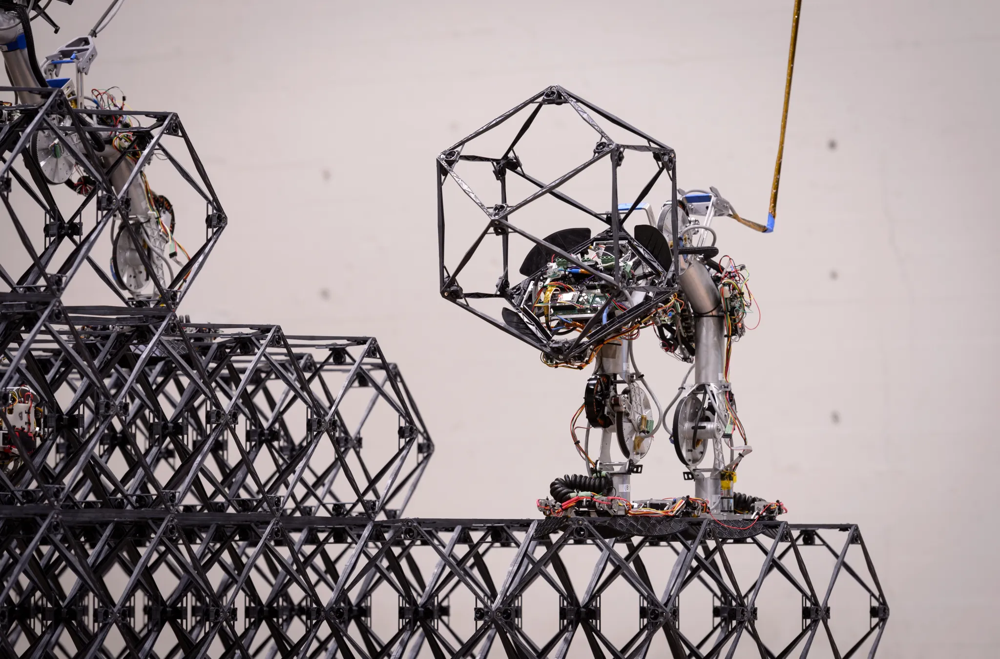
Researchers are already exploring modular, programmable physical structures that can reconfigure on demand. NASA’s recent ARMADAS project, for example, uses teams of small robots to autonomously assemble building blocks (or “voxels”) into larger structures, effectively demonstrating a form of programmable matter at architectural scale (nasa.gov). By treating physical components like pixels in a screen – a limited set of modules that can form virtually any shape – they created self-building, reconfigurable structures. Such experiments show the feasibility of dynamic assembly: a structure can be “programmed” to alter itself or build new configurations as needs evolve (nasa.gov). This is a macro-scale proof-of-concept; our hypothesis envisions similar principles applied at a micro-scale for general manufacturing.
Potential real-world applications of an AI-driven programmable matter network span across industries:
- Manufacturing & Retail: On-demand local fabrication of products would shorten supply chains dramatically. A customer could purchase a design online and have it realized by programmable matter units at a nearby hub or at home. This builds on early successes in additive manufacturing (3D printing) which already allow print-on-demand parts, reducing the need for large inventories (en.reset.org). With programmable matter, the range of producible goods would be far broader and not limited to layer-by-layer printing. Everything from electronics to furniture could be “downloaded” and materialized. Companies would focus on digital product development while physical production becomes a decentralized utility.
- Healthcare & Bioengineering: Hospitals or clinics could manufacture medical devices, prosthetics, or even bioprinted tissues on the spot as needed. Today’s additive manufacturing is inching in this direction (e.g. printing prosthetic limbs or custom implants (en.reset.org, en.reset.org). A future programmable matter system, integrated with bioengineering, might produce tailored organ implants or drug molecules on demand. Emergency medicine could benefit from devices that assemble inside the body and adapt to a patient’s anatomy in real time – for instance, a robot that transforms into a stent or a splint exactly where needed.
- Construction & Infrastructure: Large-scale, self-assembling matter could revolutionize construction. Imagine swarms of robotic matter that arrive at a construction site and morph into a building or bridge with minimal human labor. This could be invaluable for disaster relief or rapid infrastructure in undeveloped areas. As an early example, researchers suggest that self-assembling materials could drastically reduce building times in disaster recovery scenarios (orbitingweb.com). In space exploration, NASA’s vision of sending autonomous builders ahead of human missions to construct habitats is closely related (nasa.gov, nasa.gov). A programmable matter network on Earth could similarly erect shelters after natural disasters, or continually reshape factories for optimal production configurations.
- Logistics & Supply Chain: With production localized or on-site, the logistics industry shifts to supplying raw materials (the “ink” for the matter machines) and recycling used materials. Blockchain technology could be employed to track materials throughout this distributed network, ensuring that resources are reused efficiently and origin of materials is known. Proponents of an “Internet of Materials” argue that such digital tracking and coordination can maximize sustainability and reduce friction in global trade of resources
(wastelessfuture.com). In our concept, whenever a product is disassembled, its constituent matter (metals, polymers, etc.) would be catalogued and returned to the local pool, ready for the next assembly – a highly efficient circular economy. - Consumer Products & Everyday Life: The way people acquire and interact with products would change. Households might have a multipurpose matter-fabricator that replaces dozens of single-use appliances or tools. Need a screwdriver or a bowl? Download a template and the matter rearranges to form the object, then later reverts to a storage form or transforms into something else. Products themselves could be dynamic: one device might change shape and function throughout the day (e.g., a slab of programmable matter acting as a smartphone in one moment, a tablet the next, and a wearable sensor later, simply by reconfiguration). This idea echoes speculative concepts in computing and IoT where environments adapt to our needs, but here the adaptation is in physical form. It also ties into sustainability: fewer total objects are needed if each can serve multiple purposes via re-shaping, and obsolete designs wouldn’t become waste – the matter gets reused.

Notably, some early hints of this future are visible today on a smaller scale. In disaster relief scenarios, field-deployable 3D printers have been used to produce crucial supplies on-site, demonstrating the power of on-demand fabrication to save time and logistics (en.reset.org, en.reset.org). In the image above, aid workers utilize a portable printer to create water pipe fittings in a remote village, underscoring how local manufacturing can provide vital items exactly where and when they’re needed (en.reset.org, en.reset.org). A fully realized programmable matter network would amplify this capability manifold: rather than a single device printing one type of part, a coordinated swarm of matter could build complex, multi-material solutions (tools, shelters, medical devices) on the fly in crisis zones. This could dramatically improve responsiveness and lower the cost of humanitarian operations, as supplies no longer need to be stockpiled and transported over long distances.
The above applications are illustrative but grounded in current research trajectories. Each application addresses real pain points – long lead times, transportation costs, lack of customization, waste – with a radically new approach. By aligning with advances in AI (for intelligent control), automation/robotics (for physical assembly), materials science (for adaptive materials), and even blockchain (for secure coordination), the hypothesis offers a compelling framework for future industries. It suggests an era where “manufacturing-as-a-service” is ubiquitous: industries would essentially rent the utility of matter formation, much as we rent cloud computing power today. This could spur entrepreneurship as barriers to prototyping and production fall; a startup with a great product idea might not need a factory, just access to the matter network and a library of base materials.
Challenges and Feasibility
As exciting as the vision is, significant challenges—technical, economic, and practical—stand in the way. This hypothesis deliberately stretches current knowledge, and achieving it will require overcoming multiple hurdles:
- Technical Complexity & Scalability: Building programmable matter that works reliably at scale is a monumental engineering challenge. While lab prototypes (e.g. shape-shifting polymers, modular “catom” robots) show what’s possible (orbitingweb.com), scaling these to millions of units that can form large, complex objects is difficult. Ensuring precise control and communication among countless micro-scale modules pushes the limits of robotics, network coordination, and real-time computing. The precision and speed of transformations are currently limited – today’s materials cannot yet perform rapid, complex shape changes in all conditions (orbitingweb.com). Scaling up also risks failure rates; if even a small percentage of modules fail, how to maintain overall system integrity is a key question.
- High Development and Deployment Costs: The upfront R&D and infrastructure cost for such technology would be enormous. Advanced nanotechnology and AI integration do not come cheap (orbitingweb.com). Early programmable materials (like shape-memory alloys) are expensive to produce, and manufacturing millions or billions of sophisticated modules could initially be cost-prohibitive. Industries that operate on thin margins might be reluctant to adopt these until costs fall. This creates a classic “chicken-and-egg” problem: mass adoption could lower costs via scale, but getting to mass adoption requires cost effectiveness. Significant long-term investment (possibly government or large consortium funded) would be needed to mature the technology to a commercially viable point (weforum.org).
- Energy Requirements: Transforming matter isn’t free – it can demand substantial energy input to reorder structures, melt/reform materials, or power micro-actuators
(orbitingweb.com). If each reconfiguration consumes a lot of power, the system might be inefficient or unsustainable at scale. Imagine millions of tiny robots all drawing power to move; energy management and sourcing (hopefully via renewable sources) becomes crucial. Advances in energy efficiency, wireless power transfer, or even energy harvesting at micro scales would be needed. Otherwise, the carbon footprint of on-demand manufacturing could negate some of its sustainability benefits. - Materials Limitations: The range of materials that can be part of a programmable matter system will dictate what can be built. Currently, no single smart material can replicate the diverse properties of all the products we use (strength of steel, conductivity of copper, softness of rubber, etc.). A possible solution is having a set of different material modules (some metallic, some polymer, etc.) cooperating – but that adds complexity. Moreover, repeated re-use of materials must avoid degradation; ensuring that modules or base materials don’t wear out quickly after multiple reassemblies is important for longevity and cost. Research into metamaterials and durable composites will be needed to broaden capabilities (orbitingweb.com).
- Coordination and Standards: For a decentralized network to work globally, interoperability standards must be set (much like internet protocols). Different manufacturers’ matter units would need common languages to communicate, assemble, and transact. This requires consensus in industry and possibly new standards bodies focusing on “digital matter protocols.” Achieving such coordination among stakeholders (companies, governments, researchers) is a social challenge. Multi-stakeholder collaboration has been cited as essential to unlock the full potential of converging technologies (weforum.org)– here, it would apply to aligning efforts on a single grand architecture.
Despite these challenges, incremental progress is being made. The trajectory of innovation – from early 3D printing to today’s adaptive materials – suggests that many pieces of this puzzle are being investigated, just not yet unified. By identifying the hurdles above, we also identify research opportunities: each challenge points to areas for further study (e.g., energy-efficient actuation mechanisms, scalability algorithms for swarms, economic modeling for distributed manufacturing). A concerted research and development effort, perhaps akin to a “moonshot” project, could address these in the coming decades.
Ethical and Societal Considerations
Any transformative technology carries societal ramifications, and our proposed programmable matter network is no exception. It’s critical to consider the ethical dimensions and potential unintended consequences early on:
1. Workforce Disruption and Skills: A system that automates fabrication so thoroughly could displace large segments of the manufacturing and logistics workforce. Just as AI and robots are predicted to automate a significant percentage of jobs by the next decade, this would accelerate that trend. Entire job categories (factory line workers, warehouse operators, retail staff) might shrink or vanish. Society would need to manage this transition, ensuring workforce retraining and education focus on new roles (such as design, oversight of automated systems, or materials recycling management). The flip side is the potential for new industries and jobs emerging around this technology – from “matter programmers” to maintenance of the networks – but those will likely require advanced skills. Without careful planning, the divide between high-skill and low-skill workers could widen.
2. Economic and Geopolitical Impact: If manufacturing localizes globally, countries that today rely on cheap labor advantage in exports could see economic upheaval. Production might shift closer to raw material sources or consumer markets, reducing reliance on international trade of finished goods. This could alter global trade balances and even reduce conflicts fueled by competition over manufacturing dominance. Alternatively, control of the raw materials and the technology itself could become a new point of contention – for example, if only a few entities hold the IP for the matter network or if certain critical materials become the “oil” of the new economy. There are also questions about how such a network would be governed: is it centrally controlled, corporately owned, or a decentralized commons? The governance model will have ethical implications for equity and access.
3. Environmental and Sustainability Concerns: At first glance, a system that reuses matter repeatedly and minimizes transport seems eco-friendly. It indeed has the potential to “reduce waste and energy consumption” by reconfiguring the same materials for new uses (orbitingweb.com) and by cutting out the massive fuel use of shipping goods worldwide. However, the environmental footprint will depend on execution. If the modules are made of non-biodegradable materials and produced in huge quantities, end-of-life disposal is a concern
(orbitingweb.com) . Care must be taken to design recyclability and minimal toxic content from the start. Energy sources powering the network must be sustainable to truly gain climate benefits; otherwise, we risk trading physical waste for carbon emissions. There’s also a risk that ultra-convenient production could encourage hyper-consumption – if getting a new gadget is as easy as downloading an app, people might churn through products even faster, potentially increasing resource extraction. Mitigating this will require cultural shifts toward responsible consumption and possibly embedding constraints or pricing that account for environmental costs.
4. Misuse and Security: A technology capable of creating virtually any object naturally raises concerns of misuse. In a worst-case scenario, a malicious actor could program matter to assemble dangerous weapons, contraband, or surveillance devices on demand. The barrier to producing a firearm, for instance, might dramatically lower (an extension of the current issue of 3D printed guns). Preventing misuse will be a complex task: it could involve encryption and rights-management on design files, authentication layers for who can print what, and real-time monitoring for suspicious assembly patterns. There’s an ethical balance between an open platform (which encourages innovation) and a safe platform (which restricts harmful uses). Security of the network itself is also paramount – hacks or sabotage in a distributed manufacturing network could cause physical chaos, from product defects to coordinated destructive acts. Strong cybersecurity, fail-safes (like requiring certain materials not easily accessible for dangerous objects), and possibly AI-driven monitoring would be needed to ensure trust.
5. Equity and Access: To truly be transformative in a positive way, this technology would need broad accessibility. If it remains in the hands of a few wealthy corporations or nations, it could exacerbate inequality – those with access could produce wealth (and goods) far more easily than those without. Ethically, one would argue for democratization of such a network, similar to how the internet eventually became widely accessible. Open-source models or public infrastructure approaches might be considered. However, balancing that with the need to recoup investments and manage safety (points above) creates tension. Society will have to navigate intellectual property rights (for the matter modules and the product designs) to avoid monopolies while incentivizing innovation. As a thought experiment, one could imagine a future where basic goods fabrication is a public utility (ensuring everyone’s basic needs are met, akin to a universal basic income but in goods), layered over by private services for more specialized or luxury items – an ethical compromise between equity and market incentive.
In summary, the ethical landscape of an AI-driven programmable matter economy is complex. It touches on nearly every facet of society – from jobs and economics to security and environmental stewardship. Proactively addressing these considerations through interdisciplinary dialogue (involving technologists, ethicists, policymakers, and the public) will be as important as solving the technical challenges. This hypothesis is meant to provoke such discussions now, rather than after the technology matures.
Conclusion and Future Outlook
The proposed hypothesis of a decentralized programmable matter network presents a vision of industry and technology that is admittedly ambitious. It stitches together the seeds of multiple frontier technologies into a cohesive scenario for the future of business. While no company today is explicitly chasing this moonshot, the trends in AI, automation, blockchain, bioengineering, and materials science are all moving in directions that make the hypothesis increasingly plausible with time. If AI can already design novel molecules and 3D printers can fabricate complex parts, one can imagine that with enough progress, the gap to on-demand adaptive matter is bridgeable. The theoretical and practical implications discussed show both the disruptive potential and the multifaceted challenges of this concept.
Crucially, this hypothesis is not just an academic exercise; it’s a call to further research and collaborative exploration. Verifying the feasibility of an Internet of Programmable Matter will require input from many disciplines. Researchers might start by building advanced prototypes that integrate AI control with reconfigurable materials, inching toward the vision one subsystem at a time. Entrepreneurs and forward-looking companies could find opportunity in the intermediate technologies: for example, developing smarter manufacturing robots, or creating marketplaces for digital product designs secured by blockchain – each a piece of the eventual puzzle. Policymakers and ethicists, on the other hand, have the opportunity to get ahead of the curve by formulating frameworks for responsible development of such tech, informed by the considerations raised here.
In inviting further exploration, we should consider pilot projects or simulations. A possible near-term project could be a “digital matter hub” in a controlled environment (say, a research campus or smart city initiative) where a limited version of this network is deployed to handle logistics for a community – producing parts, recycling waste, responding to local needs – to study its impact. Such experiments can provide data on efficiency, community acceptance, and unforeseen issues.
In conclusion, the concept of AI-driven programmable matter networks pushes the envelope of what might be achievable in the coming decades. It paints a picture of a future where the boundaries between the digital and physical blur, and where industries become radically flexible, efficient, and localized. Whether or not the hypothesis materializes fully, exploring it yields valuable insights. It forces us to question current assumptions about production and consumption, and to innovate toward a future that could be more sustainable and equitable if guided conscientiously. The hope is that this research-backed vision sparks discussion and inspires bold research – because today’s hypothesis could be tomorrow’s transformational reality.
Sources:
- Medikepura Anil, A. (2025). Technology convergence is leading the way for the fifth industrial revolution. World Economic Forum weforum.org
weforum.org
- RESET.org (2018). 3D Printing: Adding a Sustainable Dimension to Modern Life. (Royte, E. quoted) en.reset.org
en.reset.org
- Orbiting Web (2023). Programmable Matter – Understanding the Concept with Real-World Examples orbitingweb.com
orbitingweb.com
- Wikipedia. Post-scarcity economy – Speculative technology and nanofactories en.wikipedia.org
- Mavropoulos, A. (2018). Blockchain stimulates the Internet of Materials. Wasteless Future wastelessfuture.com
- NASA/D. Hart (2024). Automated Reconfigurable Assembly – Science Robotics publication summary nasa.gov
nasa.gov
- Orbiting Web (2023). Challenges and Opportunities of Programmable Matter orbitingweb.com
orbitingweb.com. - RESET.org (2018). Humanitarian uses of 3D printing en.reset.org
en.reset.org.